Ask Insights (AI)
Ask natural-language questions about locations, costs, workforce, risk, incentives, and EDD regions, and get a grounded answer with a data table, sources, and follow-up suggestions, saved to a conversation you can revisit or share.
Before you start
- Ask is one of the Insights screens, alongside Explore, Analyze, Incentives, and Reports. Open Insights from the workspace switcher in the header. If Insights is not offered there, your account has not been granted that product; ask an account admin.
- Ask answers only from Insights data: state, metro and county economic and demographic figures, incentive award and program data, and EDD region priorities. It has no access to your account's contacts, responses, opportunities, or other Incenti records, and it doesn't browse the web.
Steps
Start a conversation
Open Ask. A new session shows What can I help you find? with a row of suggestion chips, each an example question grouped under a category (Site Selection, Comparison, Analysis, Research, Cost Analysis, Strategy, Incentives). Click a chip to ask it, or type your own question in the box at the bottom, labeled Ask about locations, costs, workforce, risk, or strategy…, and press Enter or click the send button.
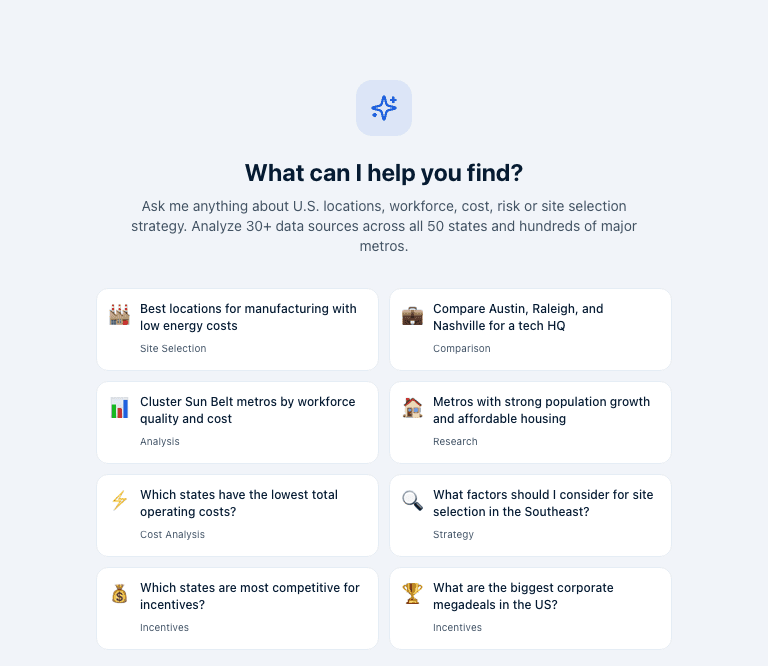
While an answer is being worked out, the box shows Analyzing data sources… and both the input and the send button are disabled, so you can't stack two questions at once. A question is limited to 1,000 characters.
You'll typically ask Ask to benchmark your own market: "How does my county compare to nearby metros on workforce and cost?", "Which states are most competitive for incentives?", or "What are the biggest corporate megadeals in the US?" to see what competitors are offering.
You'll typically ask Ask to shortlist and compare candidate locations: "Best locations for manufacturing with low energy costs", "Compare Austin, Raleigh, and Nashville for a tech HQ", or "What factors should I consider for site selection in the Southeast?"
Read an answer
Each answer arrives as a card: a short summary, a data table (state, metro, or incentive figures, with score columns shown as colored badges), a Why This Matters callout with the analytical takeaway, the Sources the answer drew on, and 2–3 Follow up questions you can click to continue the conversation. Asking a follow-up sends it as the next message in the same conversation.
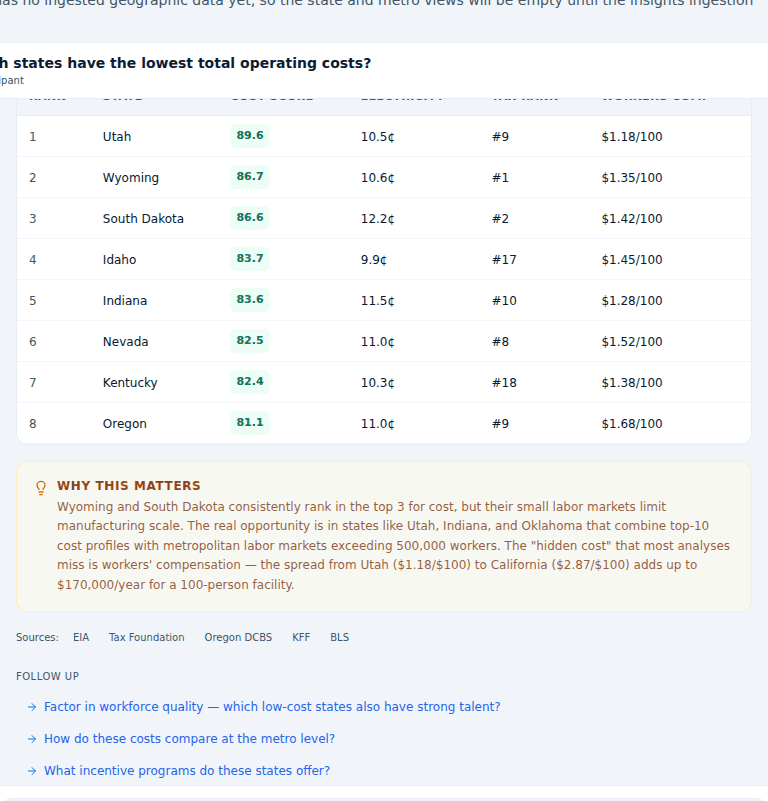
Tables are capped at around 10 rows — for a broader question Ask ranks and takes the top ones rather than listing everything. Score badges are colored by band: 70 and above green, 50 and above blue, 35 and above amber, below that red. An answer whose card can't be read back (an older or unusual saved answer) renders as plain text with no table, sources or follow-ups.
There is no export or copy button on an answer table. To work with the underlying figures in a spreadsheet, use Explore's CSV export or the Incentives screen's Industries export instead.
Manage conversations
The Conversations panel on the left lists your past sessions by name, participant count, and how long ago the last message was sent. A session with no messages yet shows No messages in place of a time, and an empty panel reads No conversations yet — Ask a question to start one. Click New conversation to start a fresh one.
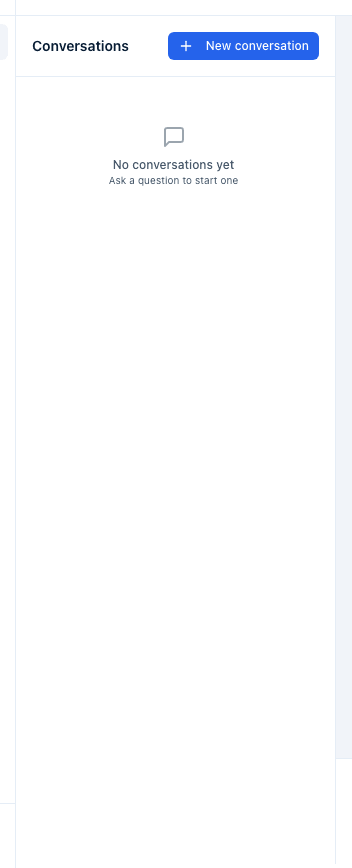
The ⋮ menu on a row in the panel offers Rename and Delete. The ⋮ menu inside an open conversation's header offers Rename, Share, and Delete — Share is only in the header menu, not on the sidebar rows.
- Rename opens Rename conversation with a Conversation name field; saving shows Conversation renamed.
- Delete asks Delete this conversation? and removes the conversation and its messages for every participant, including anyone it's been shared with.
Share a conversation
Open the conversation, then use its header ⋮ menu → Share to open Share conversation. The dialog has two sections: Current Participants and To be Added, with a checkbox per account member.
- Turn on Add all account members to add everyone on your account at once. When they are all already participants, the dialog says All account members are already participants instead.
- Uncheck a current participant to remove them, then Save. Success shows Participants updated successfully.
- You can't remove the last participant (Cannot remove the last participant) and you can't remove yourself (You cannot remove yourself from the conversation).
Everyone you add can read and send messages in that conversation, not just read it — a shared conversation is a shared workspace, not a published transcript.
What Ask can and cannot answer
Ask is grounded: it answers only from data that is put in front of it for your question, and it will say it can't answer rather than invent a figure. What it is given is:
- Every served state, with its full metric set.
- The top 50 metros by composite score, plus up to 3 more metros named in your question.
- Up to 3 county snapshots, resolved from the places your question names.
- The national incentive rollup (all-time raw and the 2008-onward normalized view), the 30 largest megadeals, and every state's Incentive Competitiveness Score.
- A summary of each state's Programs Offered catalog — how many programs and how complete the coverage is — with individual program details fetched as needed.
- The national EDD priority mix, with individual district details fetched as needed.
There are no city rows
Ask has no city-level data. When your question names a city, it maps that city to its county and, where relevant, its metro, and answers from those. "Lexington, KY" is answered as Fayette County and the Lexington metro. That is also why asking about more than three counties, or more than three metros beyond the top 50, in a single question will leave some of them out — ask about them in smaller groups.
If you need city-level figures, use Explore, which does serve them. See City-level data.
What the Sources labels mean
The Sources chips name where the figures came from:
| Chip | What it covers |
|---|---|
| Census ACS, BLS, EIA, Tax Foundation, FEMA, HUD | Economic and demographic figures for states, metros and counties |
| Incenti Subsidy Intelligence | Incentive award dollars, megadeals, competitiveness scores |
| Incenti Program Intelligence | Named state incentive programs and program counts |
The award and program datasets are Incenti's own compiled intelligence, and Ask will not name or speculate about the upstream sources behind them. See How Incentive Intelligence figures are computed.
Where a state's program catalog is only partly verified, Ask says the list is verified but not exhaustive; where a state hasn't been catalogued yet, it says so rather than implying the state has no programs.
What a Cached answer is
When Ask can't complete a live analysis, it falls back to a small catalog of stored answers and marks the card Cached answer. That happens on a service failure, a network drop, a malformed response — and also when your question is over 1,000 characters, which the app treats the same way as an outage.
Part of that catalog is computed live from the incentive dataset and is current. The rest — the market-style answers about manufacturing, tech headquarters and similar — are static tables frozen in July 2026, kept only so a failed question still returns something useful. Their figures can disagree with Explore.
Treat a Cached answer as illustrative, not as current data. If the numbers matter, ask the question again once, and check anything you plan to use against Explore or Incentives.
What happens next
- Every message you send and every answer Ask gives is saved to the conversation, so reopening it later shows the full history. The most recent 100 messages load when you open one.
- Sending your first message in a new session creates the conversation and
updates the page's URL to
/insights/ask?c=<id>so you can bookmark it. A conversation you are not a participant of shows the not-found page. - A new conversation is named automatically from your first question, trimmed to 57 characters with an ellipsis if it's longer. Rename it any time.
- A conversation is visible only to its participants: the creator, plus anyone added through Share. Other account members can't see it unless you share it with them.
Common questions
Q: Can it see my responses or pipeline? A: No. Ask only has access to Insights data — states, metros, counties, incentive awards and programs, and EDD regions. It cannot read your account's contacts, responses, opportunities, or any other Incenti records, and it doesn't browse the web.
Q: Why does Ask say it has no data for my city when Explore shows it? A: Ask has no city rows. It resolves a city to its county and metro and answers from those, so a small city with no distinct county story can come back thin. Explore does serve city-level indicators — use it for city figures and Ask for state, metro and county questions.
Q: Why did my question come back as a "Cached answer" even though nothing was down? A: The most common cause is length: a question over 1,000 characters is rejected and the app falls back the same way it does for an outage. A brief network drop does the same. Shorten the question and ask again.
Q: The cached answer's numbers don't match what I see in Explore. Which is right? A: Explore. The market-style cached answers are static tables frozen in July 2026 and kept only as a fallback, so they can be out of date. Anything marked Cached answer should be re-asked rather than cited.
Q: What does the "Incenti Subsidy Intelligence" source chip mean? A: It's the label for Incenti's own compiled dataset of disclosed incentive awards — the same dataset behind the Incentives screen. "Incenti Program Intelligence" is the equivalent label for the verified catalog of programs states currently offer. Ask will not name the upstream sources behind either.
Q: Why won't Ask name the specific incentive programs in my state? A: Because that state's program catalog isn't verified yet, or is only partly verified. Ask will only name programs that are actually in the catalog, and it says the list isn't exhaustive rather than guessing. Check the Programs tab on Incentives for that state's coverage status.
Q: Can the people I shared a conversation with ask their own questions in it? A: Yes. Every participant can send messages, not just read. If you want a read-only copy, don't share the conversation — paste the answer somewhere else instead.
Q: Why is my conversation named the first thing I typed, cut off with "…"? A: New conversations are auto-named from your first question and trimmed to 57 characters. Open it and use the ⋮ menu → Rename for something shorter.
Q: Can I export or copy an Ask table? A: There's no export button on an answer. For a file, use Explore's CSV export for state, metro, county and city metrics, or the Industries tab's CSV and XLSX exports on Incentives for award data.
Q: Are my conversations visible to teammates? A: Only if you share them. A conversation starts visible only to you; use the Share option in the open conversation's ⋮ menu to add specific teammates or the whole account. The ⋮ menu on a sidebar row has no Share option — open the conversation first.
Q: How current is the answer? A: Answers ground on the same state, metro, and county data shown in Explore, and the same incentive and EDD data shown in Incentives, each refreshed on its own schedule. A cached answer (marked Cached answer) comes from a stored catalog instead of live analysis.
Related
Last updated on